

With UAE Team Emirates’ Wellens taking the win and Visma’s Campenaerts finishing second on stage 15, the key helpers for the two general classification leaders sped through the sweltering heat of Carcassonne at an average speed of over 47 km/h over 170 km with 2300 meters of elevation gain [16], just as they had done at the start of stage 1, where they maintained an identical pace. This time, however, it should be noted, they were riding after the strain of 14 days of racing and the brutal Pyrenean stages. The formation of the breakaway was highly controversial between UAE Team Emirates and Visma, and the subsequent discussion on the rest day revealed just how ruthless the peloton has become [17]. Wellens and Campenaerts were probably positioned in the breakaway as relay points for potential attacks from their team leaders, but after the breakaway had built up a lead of over 6 minutes, it would have been a nice gesture to show some rest and, above all, to allow the stage win to a smaller team. One would certainly have wished it for third-placed Alaphilippe and his Tudor team. Especially since this old warhorse suffered a dislocated shoulder in a crash during the stage, which he popped back into place himself, all while hurtling along at 50 km/h; this episode also leaves the knowledgeable observer speechless [18]. To make matters worse, Wellens wins the stage with a gigantic 43km solo attack, and there are no signs of the riders showing any signs of the expected fatigue. Also telling is the way Team RBH treated their rookie star Lipowitz, who, after all, was the best young rider, wearing the white jersey and with a chance of a podium finish. After the mass crash, he was left to fight for his place in the peloton alone, without a single teammate sending him back to support him [19]. This is another serious tactical blunder after the crosswind disaster on stage 1. RBH’s questionable team selection makes the actual protagonists for such tasks (Moscon, van Dijke, Pithie) seem like ghosts who never appear when needed and were otherwise virtually invisible for the three weeks. Why, given Roglic’s and later Lipowitz’s ambitions for the overall classification, only one nominal mountain domestique, Vlasov, who never reached his usual level of performance, was selected is one of the many mysteries surrounding an obviously uncoordinated sports management. It was bad luck that Meeus, who crashed badly and suffered serious injuries, could no longer participate in the sprint finishes; hats off to him for even battling his way to Paris. His lead-out man, van Poppel, is another nomination flop, knowing full well that his wife was almost certainly due in the three weeks leading up to the birth, and the expectant father would consequently have to leave the Tour [20]. This might be explained by contractual guarantees that the management of the riders involved in the Tour de France had assured them of a start. Yet another of the unsavory new excesses in modern professional cycling.
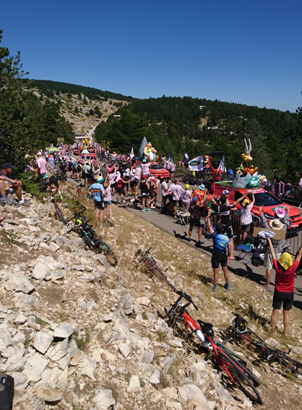
While riding the route up Mont Ventoux the day before the 16th stage, the author noticed a new, kilometer-long strip of asphalt in the lower, steep section, which was significantly easier to ride on compared to the rough main surface. One would expect the scouts of the highly paid professional teams to recognize this competitive advantage and pass it on to their riders. However, the live footage surprisingly shows that both the leading groups and the GC favorites simply ignore this helpful surface. Incidentally, this is also true for all the “cycling experts” at the publicly funded microphones.
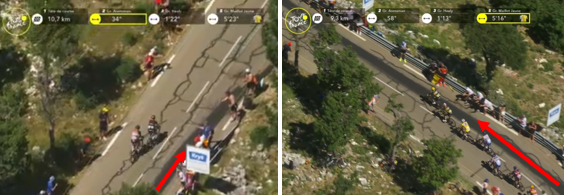
Tactically, Visma pulled out all the stops that day, with van Aert, like a berserker, catapulting the GC favorites group into the lower part of Mont Ventoux for his captain Vingegaard, until he almost collapsed from exhaustion while trying to break away. Kuss and Yates set a killer pace on the steep section, completely isolating Pogacar from his teammates. Vingegaard’s attacks came at just the right time; he first caught up with Benoot, who had been sent into the day’s breakaway, and then launched another attack by the Dane to the second breakaway, Campenaerts, who was also dropping back from the leading group and waiting for his leader. Everything was textbook tactics, except for the target of all this effort, Pogacar, who simply couldn’t be shaken off even after two further attacks from Vingegaard.
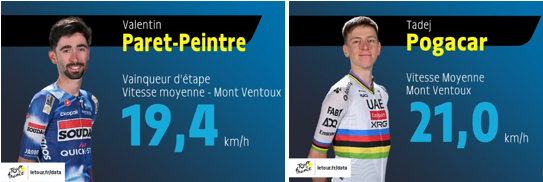
The series of attacks in the leading group between Healy and Paret-Peintre is equally spectacular, with the Frenchman ultimately coming out on top. The speeds at which the leading riders storm the barren giant of Provence are once again breathtaking and raise critical questions.
On this stage, RBH finally delivered in terms of race tactics in the fight for a podium finish in the GC and to secure the white jersey. Roglic and Lipowitz, as well as van Dijke, who was called back from the leading group, worked effectively together and were able to keep their main rival in the general classification and the young rider classification, the young Scot Onley, at bay.
Pogacar sets a new ascent record on Ventoux, with a time of 54 minutes and 41 seconds, approximately one minute faster than the previous record holder, Mayo, from 2004 [23]. The two superstars, Pogacar and Vingegaard, mobilize an average power output of 6.5 W/kg for about an hour, dimensions that certainly raise legitimate questions about how they were achieved [3]. His completely unnecessary attack on Vingegaard on the final ramp certainly had nothing to do with the ambition of supposedly still wanting to win the Strava KOM [24], but was clearly aimed at mentally breaking his main competitor. Not a nice gesture; even Armstrong showed more sportsmanship at this point when he let Pantani go first in 2000 [25]. Pogacar’s helper Politt also seems to overplay his helper role by trying to prevent breakaway attempts from the peloton by all means, including unsportsmanlike ones, so that his captain can win on the mythical summit [26].
You could try renting an e-bike in Bedoin, at the foot of Mount Ventoux, and then attempting to climb this monster mountain at a constant 20 km/h. If you end up stranded with a seized piston in both legs or a burnt-out motor, you’ll get a sense of the extraordinary feats these cycling gladiators are capable of. Then it becomes understandable that Uno-X’s captain, Johannesen, who finished eighth overall, collapsed on the summit of Ventoux [27]. Incidentally, the entire 172 km stage with almost 3000 meters of elevation gain was completed at a phenomenal average speed of 42.3 km/h [28]!
The stage winner, Paret-Peintre, who falls into the ectomorphic leptosomic category (one could also describe it as anorexia athletica), weighs only 52 kg at a height of 1.78 m. It is surprising that there is not a similar, justified critical discussion as there was about the Tour de France Femmes winner Ferrand-Prevot [29].
