

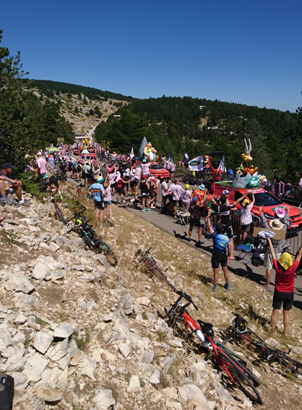
With the mountain time trial from Loudenville up to Peyragudes, a climb of 11km and 650m, Pogacar cemented his unassailable lead in the general classification with another stage win. Only Vingegaard, 37 seconds behind, could keep pace with the “smiling man” (Pogacar’s nickname), while all other competitors were left far behind. Time trial world champion Evenepoel suffered a debacle [1]. A crash-damaged Pogacar flew uphill at an incredible average speed of 28.5km/h [2], which corresponds to approximately 7.5 watts/kg [3]! Values that are, quite literally, statistically beyond belief in the long term.
The different approaches of the individual teams and top favorites regarding their technical setup are highly interesting. The course was extremely varied, beginning with three flat kilometers where time trial bikes clearly had an advantage. The subsequent sectors started with a 4.5% gradient, then increased to 6-9%, and finally climbed to a gradient of up to 13% in the last 900 meters – classic terrain for specialized climbing bikes. The majority of the riders opted for the more traditional aero road bike; only four riders (Vingegaard, Lipowitz, Evenepoel, and Roglic) chose a modified time trial system. In this case, the aero bars were raised by up to 2 cm to allow for a more upright position and greater power transfer on the uphill sections. Every gram of extra weight was saved, and in some cases, paint layers or bar tape were omitted to get as close as possible to the UCI weight limit of 6.8 kg [4].
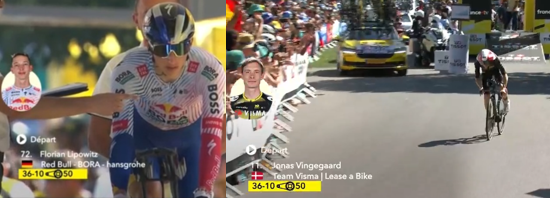
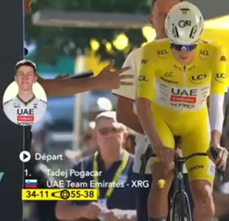
The speed differences in the individual time trial sections place enormously variable neuromuscular demands on the riders. Extremely power-oriented with high gear ratios in the flat section, and then significantly more cadence-oriented with diametrically opposed maximum motor loads in the steep sections. Pogacar, with his chosen bike setup and gear range, seems to have managed the switching between these changes in riding rhythm better than Vingegaard, although theoretical simulations would certainly have recommended the time trial bike setup [6].
Vingegaard still completed an excellent mountain time trial, but then Pogi came along and was 36 seconds faster. This also brings back memories of when a then-dominant Ulle was beaten by the dominant rider of his time, Armstrong, in the Alpe d’Huez mountain time trial. And as we all know, not everything was above board there either. History repeats itself [7]!
On the 14th stage, in significantly cooler weather conditions that should have further burdened the peloton and correspondingly reduced their performance, an incredible average speed of 37 km/h was achieved over 183 km and an extremely difficult 5000 m of elevation gain in the mountains. Certainly, the use of aerodynamically optimized equipment [8] and the team tactics of drafting on the climbs [9] contributed to these exorbitant performance figures. After all, the power savings at the same speed can amount to up to 30 watts.
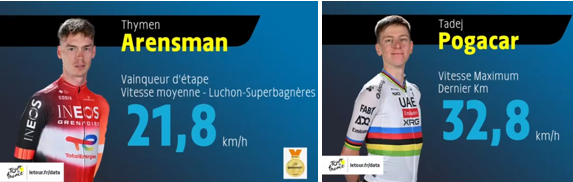
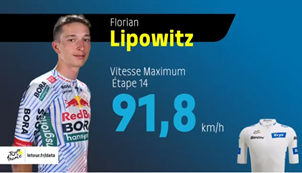
In terms of performance physiology, these are enormous differences at the sustained power thresholds, with corresponding highly significant competitive advantages/disadvantages for the individual teams and their riders. Nevertheless, one wonders why neither injuries [10], illness [11], accidents [12], nor even the organizer’s psychologically traumatic choreography [13] had any limitations on Pogacar’s performance. While Evenepoel had to abandon the Tour on this 14th stage due to the aforementioned factors, Evenepoel is demonstrably in the same exceptional category of physical talent. However, he is still subject to the natural limits of regeneration, which are inexplicably disregarded in Pogacar’s case. This should certainly raise some eyebrows, especially when even a former Tour winner reacts with speechlessness and disbelief to Pogacar’s performance [14].
