

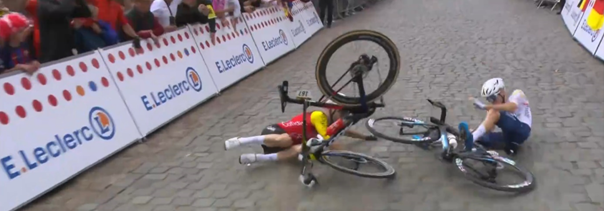
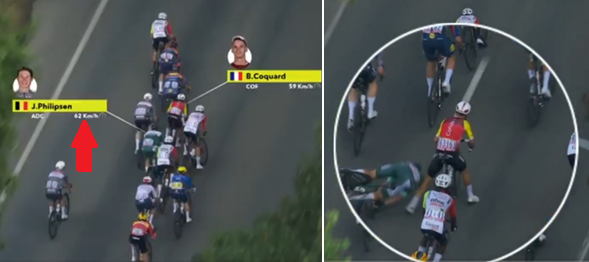
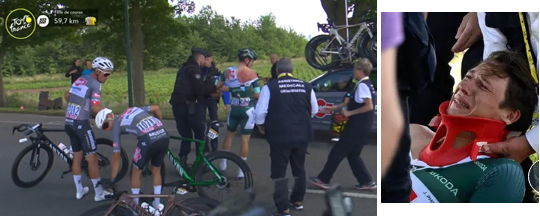
Instead of drawing consequences from the shocking incident at the intermediate sprint and treating each other more defensively and respectfully, there was another violent clash 3km from the finish and on the final straight, resulting in a corresponding increase in the Tour’s injury list. The pressure to succeed, the fight for contracts and sponsorship money, was mercilessly played out on the asphalt in all its repulsive depravity.
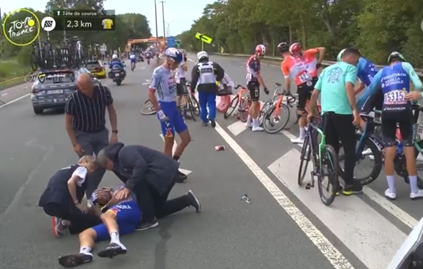
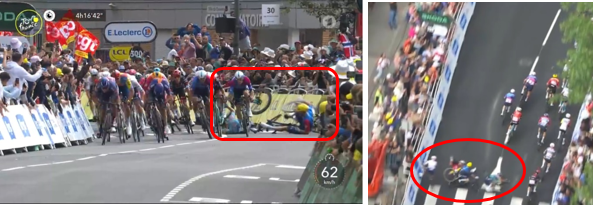
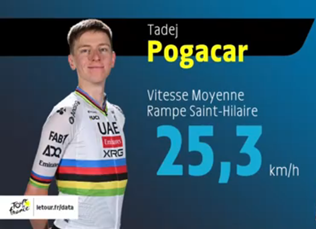
In ancient Rome, wild animals and bladed weapons were needed for a bloody spectacle to entertain the masses in the Circus Maximus; the invention of the bicycle has turned the open road into a mobile, modern amphitheater, and TV images deliver the massacre directly to the gawking public. This is certainly not good publicity for cycling; after three stages, the sports purist finds it difficult to continue watching the spectacle. The UCI may be diligently and justifiably handing out yellow cards, but this seems to have no effect on the peloton [18]. On stage 4, GC contenders Pogacar and Vingegaard provided the ultimate proof that there seems to be no limit to their upward performance. Their attack on the Saint-Hilaire ramp, with gradients of up to 15%, resulted in Vingegaard delivering his best 1-minute split ever [19]. The speed at which these two high-flyers stormed up the ramp was breathtaking.
Unlucky RBH team captain Roglic once again caused a bizarre incident, as he seemed to attract crashes like a magnet, triggering a technical defect in his drivetrain. He then finished the stage on the steep final climb, using the large chainring and exerting immense effort. Normally, he would have had to walk up it, as such a feat of strength is practically impossible. One has to tip one’s hat to this extraordinary performance from the old warhorse [21]. Evenepoel’s apparent problems with proper waste separation cost him a 500 Swiss franc fine and 25 world ranking points [22].
