

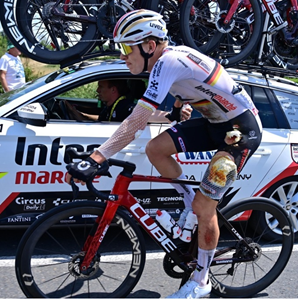
The level at which the subsequent stages are completed doesn’t decrease, as one might expect; the peloton simply pushes even harder, defying all logic of metabolic wear and tear. With an average speed of 48.1 km/h (over 200 km and 2100 m of elevation gain [8]), they continue the day after the brutally difficult 6th stage as if there had been no prior exertion whatsoever. The first hour of the race couldn’t even be followed on a souped-up speed pedelec, because one would have to constantly maintain around 60 km/h.
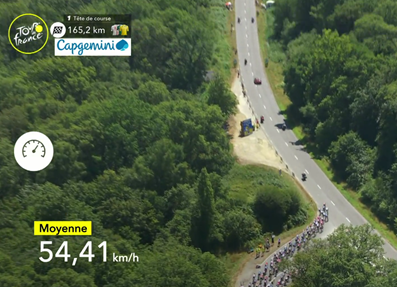
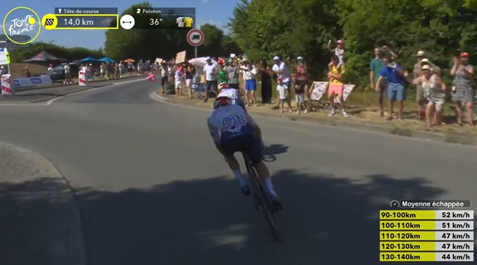
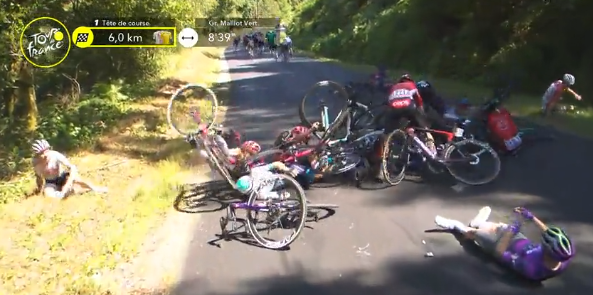
The only sign of the peloton’s fatigue is the violent crashes in the stage finale, which once again heavily replenish the Tour’s medical supplies. Meanwhile, the obligatory test for concussion or traumatic brain injury has become standard practice for the medical support staff in the Tour caravan [11]. It is nothing short of a miracle that most riders manage to emerge relatively unscathed from the carnage of these crashes and continue the race.
Stage 9, with an average speed of 50 km/h over 174 km and 1000 m of elevation gain [12], became the second fastest Tour de France stage of all time. It was particularly remarkable that this incredible pace was maintained during a 170 km breakaway by the Alpecin duo of van der Poel and Rickaert, who were held off the peloton by the narrowest of margins, only 800 m from the finish line [13]. German champion Georg Zimmermann was brought down in a split second by a water bottle dropped by the peloton, which caused him to crash at full speed. Badly injured, bleeding, and patched up with numerous bandages, he managed to reach the finish line within the time limit, an extraordinary feat of will in his condition, but was subsequently forced to abandon the Tour [14].
After Irishman Healy, who had already caused a stir on stage 6, maneuvered himself into the yellow jersey, the usual wave of illness began in the peloton as a consequence of the strain. Besides Austrian Gall [15], superstar van der Poel was also affected, which didn’t stop him from continuing to deliver incredible performances, narrowly missing out on stage win again by finishing third on stage 11 [16]. And suddenly, colds were back to normal, and “Corona” had miraculously disappeared from mainstream terminology because the politically orchestrated Covid fairy tale had completely evaporated. A proper media reckoning with this scientific fraud and medical crime is still not taking place because the investigative brain cells of the mainstream media remain in ideological and intellectual lockdown [17]. The case of van der Poel proves that the age-old rule of voluntary abstinence from sports during respiratory infections still holds true, without resorting to pointless and health-endangering measures such as PCR tests, masks, or experimental gene injections. Despite having a cold, he pushed his body to its limits with epic attacks and, after an insect bite [18] on the 12th stage, developed pneumonia [19], forcing him to abandon the race. The insect venom could explain the progressive immune activity that allowed the respiratory infection to escalate under the extreme stress. It is truly incomprehensible that team doctors and the sports management, despite the mandatory, continuous health screenings in modern competitive sports, even exposed him to this risk in the first place.
Pogacar’s crash in the finale of stage 11 has caused a completely inappropriate outcry on social media. Where is the reaction from the self-appointed guardians of woke virtue, Trusted Flaggers, and other denunciation portals against hate speech, who otherwise report every harmless and justified comment from critical citizens against the utterly incompetent political class? One has to give Pogacar credit for how professionally he handles this side issue, taking his competitor out of the firing line, all while under the considerable stress of the Grand Tour where every minute of recovery counts [20].
This stage demonstrated once again how closely egoism and respect are intertwined in the peloton. First, contrary to the unwritten rules of cycling, an attack was launched during a pit stop in the feed zone [21], then the group of favorites waited fairly for Pogacar when he crashed in the finale [22].
On stage 12, a closer look – the kind of thing the full-time reporters with their princely fees would be responsible for – would have revealed that something was wrong with Evenepoel. Underneath his badly ripped jersey, an unusual application of tape was visible in the caudal lateral right thorax, raising eyebrows among any expert. A few days later, the significance of this area became clear. Evenepoel was concealing a rib fracture there, which would ultimately force him to abandon the Tour de France [23].
