

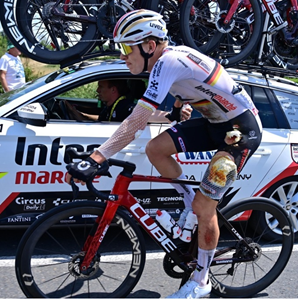
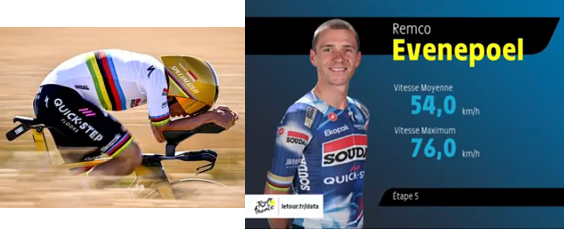
The 33km individual time trial around Caen officially opens the battle for the overall classification. Many of the GC riders are clearly paying the price for the extremely explosive and grueling finale of stage 4. Vingegaard and his teammates lose well over a minute to Pogacar and Evenepoel, a considerable deficit over such a short distance. Roglic, the unlucky rider who crashed and suffered a mechanical failure on stage 4, was understandably unable to execute his planned power-intensive effort (68-tooth chainring!!) in the time trial due to his weakened condition. The trend towards increasingly outlandish gear ratios continues seamlessly in 2025. Roglic, with his 68×10-28 cassette, stands out as particularly ambitious. Due to his age, he has to operate in the power-torque sector, as his neuromotor sensibility has reduced his capacity for high-frequency strategies. His younger competitors use significantly more moderate chainrings: Evenepoel 64×11-30, Vingegaard 64×10-28, and Pogacar 62×11-34 with 165mm crank length. Aerodynamic perfection and stylistic aesthetics, coupled with enormous pain tolerance for medium-length, highly explosive periods of exertion, and an intuitively perfect pacing strategy, are currently mastered by no one better than the discipline world champion Evenepoel. With an almost unbelievable average speed of 54 km/h, the Belgian races around the course, which still includes a climb of nearly 200 meters. Despite this, he only gains an average of 0.5 seconds per kilometer on the top favorite, Pogacar, and thus cannot prevent the latter from taking the lead in the green and polka dot jerseys for the points and mountains classifications at the end of the stage, in addition to the yellow jersey of the general classification [1].
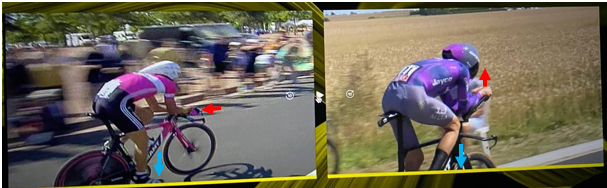
A significant factor in the exorbitant performance improvements in modern individual time trials is the modification of custom-made carbon monocoque handlebar extensions. The instep grip on the extension simply allows for higher counterforces than were possible 20 years ago with the far-forward hand positions used in aerodynamic tests with the Superman position, Obree style, and similar techniques. And all this without significant loss in the fluid dynamic properties of the slightly larger frontal areas, compared to the extremely low upper body positions of the time, a fact that can now be demonstrated using CFD models (computational fluid dynamics) [3].
Stage 6 was once again ridden at a brutal average speed of 46 km/h over 200 km with 3300 m of elevation gain [5]! These absurd performance figures were catapulted into a whole new dimension by the eventual winner, Healy, who largely single-handedly generated this insane pace in the finale! And once again, it’s worth listening closely to the commentary from Eddie Dunbar (Team Jayco-AlUla, fourth in the stage on Eurosport), who was riding in the day’s breakaway. “It was brutal. We never let up. The peloton kept going, they didn’t give up. And even when they finally did, we kept going full throttle. It was an incredibly strong group and everyone did their part. It was an unbelievable performance from Ben; how he managed to get away for 2:30 minutes is beyond me. Hats off to him. I’m really exhausted.” Dunbar, like Healy, is also Irish; they know each other from their time together in the national youth squads. Dunbar is better able than anyone to perfectly assess Healy’s performance capabilities. And quite obviously, this was an inexplicable, statistically significant outlier on that day, so there must have been some very special additives in Healy’s water bottles, the persistent skeptic would critically point out. But as usual, that doesn’t seem to interest anyone in the accompanying press corps. One only has to look at the completely exhausted superstar van der Poel, who also belonged to this illustrious leading group, after the stage, barely managing to slip into the yellow jersey by a single second, to get a sense of what transpired on the roads of Normandy that day [6]. Another top star of the scene, van Aert, once again starts the Tour while ill, as he did at the Giro, and is already riding his second Grand Tour this year as a “rehabilitation measure”—for risks and side effects, just ask your sports director or sponsor [7].
