

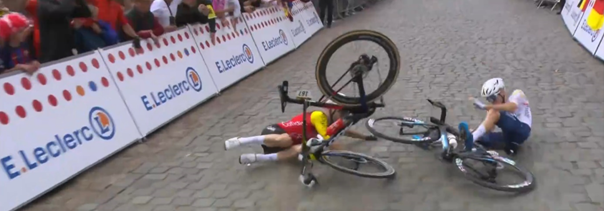
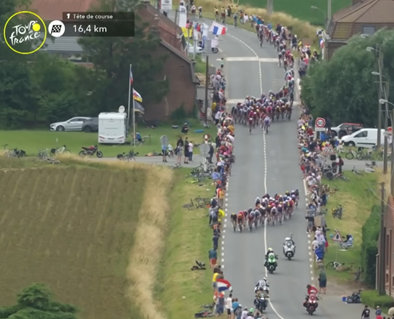
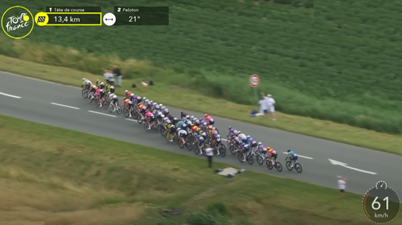
The opening stage of the Tour, in the former coal-mining region of northern France, provided clues after just a few kilometers as to the increasing recklessness with which the peloton would race through France. This was initially evident in the battle for the first points in the special classifications, with the two breakaway riders, Thomas and Vercher, managing the feat of taking each other out on the climb to Mont Cassel (see article cover photo) [1]. The early, crash-related withdrawals of such experienced riders as Ganna and Bissegger only hint at the wild battles for position that took place in the peloton [2]. In his podcast [3] after the first stage, Geraint Thomas provided the ultimate proof of just how brutal everyday life in the cycling world has become with the telling statement: “If only I had quit last year…” Even the assumption that such a flat stage, completed at an enormous average speed of almost 48 km/h [4], is actually a matter for the sprinters and their teams, is rendered absurd in the finale, where the battle among the GC contenders is unleashed, tearing the entire peloton apart. 16.8 km from the finish, Visma Lease a Bike splits the peloton on the crosswind side at 60 km/h, emerging from an inconspicuous roundabout. The big losers on the first day, with almost 40 seconds lost in the GC, are Roglic/Red Bull Bora Hansgrohe (RBH) and Evenepoel/Soudal Quick Step (SQT). It is completely incomprehensible that such renowned World Tour teams with their highly paid rosters make such rookie mistakes and are outclassed by teams with significantly smaller budgets and resources [5].
It is extremely curious that Lenny Martinez limped across the finish line completely exhausted on this first stage, 9 minutes and 11 seconds behind, only to then compete for the King of the Mountains jersey against absolute superstars Pogacar and Vingegaard later in the Tour [7]. How is it possible that a rider arrives at the Tour in such seemingly poor condition and then miraculously recovers in such a short time under extreme conditions?
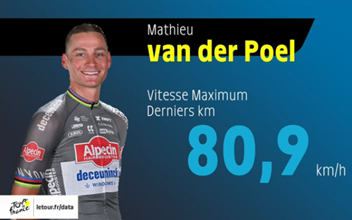
Technically, some athletes and teams are continuing the trend of using single chainrings from 2024. Vingegaard, for example, rides most stages entirely with a 50×10-36 cassette [8]. After the previous day’s debacle, RBH launches a completely pointless, energy-sapping attack by their young star Lipowitz [9], the first indications of the team management’s total lack of planning, which would be followed by further completely incomprehensible escapades during the Tour. In stark contrast, the much more financially limited Alpecin Deceuninck (ADC) team acts quite differently. Their superstar van der Poel wrestles down the high-flying Pogacar at the finish line and prevents him from dominating the stage again early. The alleged reason for the impressive form of the ADC’s top athletes, including van der Poel and Philipsen, is explained by a special hyperthermic training methodology, so-called heat training. The main performance-enhancing effects lie primarily in the increase in blood volume and the number of reticulocytes/erythrocytes [10]. However, this measure is not as new as propagated in various online portals; it has already been used in numerous variations by Central and Northern European athletes in the past to prepare for extreme climatic conditions at competition venues during key season events [11]. I vividly remember the indoor cycling training sessions of some athletes in the sauna, wearing rain jackets, until they were on the verge of total thermodynamic suicide, in preparation for the 1996 Atlanta Olympics.
The crash festival of the cycling-mad egomaniac group continued its unfortunate continuation on stage 3. Just like in the mountain classification skirmish on stage 1, this time the sprinters swept each other apart in an intermediate sprint, eliminating the sprint superstar of the scene, opening stage winner and wearer of the green jersey, Jaspar Philipsen.
Philipsen’s teammate Jonas Rickaert aptly commented on the incident: “At first I was angry with Coquard and wanted to confront him. He said he couldn’t do anything about it. But it’s not the first time he’s taken excessive risks in an intermediate sprint. And that’s despite the fact that he can only finish sixth or so in the points classification at best. Sprinting at the finish, okay. Then it’s about winning. But to risk his life for ten points, I’m simply speechless.” [15] It seems like a twist of fate that Coquard, of all people, suffered the misfortune of breaking two fingers while taking a water bottle and having to abandon the race on stage 12. [16]
